.avif)
5 Questions Every CEO Should Answer Before 2025 Ends
5 Questions Every CEO Should Answer Before 2025 Ends
The $10.22 million question your board will ask in January
There's a moment every year when executives face uncomfortable questions they should have asked months ago. For cybersecurity, that moment is January—when your cyber insurance renewal hits, when a customer demands SOC 2 before signing, or when a competitor's breach makes your board suddenly curious about *your* security posture.
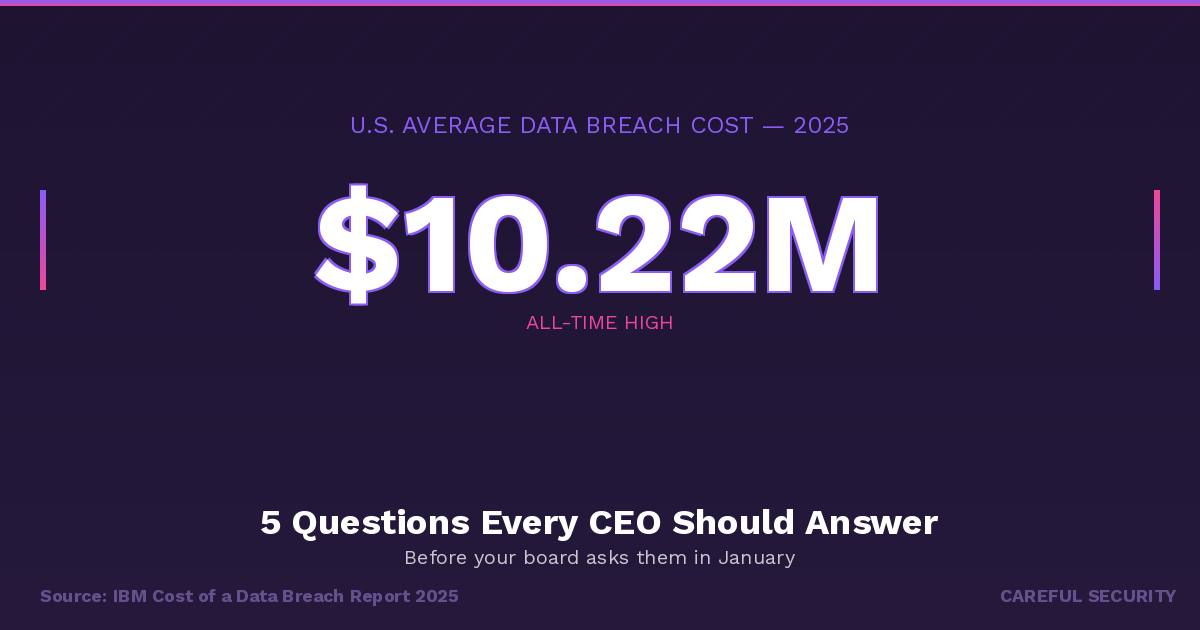
The IBM Cost of a Data Breach Report 2025 just dropped, and the numbers tell a split story: globally, breach costs dropped 9% to $4.44 million. But for U.S. companies? Costs jumped to an all-time high of $10.22 million per breach.
The difference? Companies that invested in the right controls saw costs plummet. Companies that didn't paid the price—literally.
Here are the five questions that separate the two groups.
---
1. "Would we even know if we were breached?"
The 2025 IBM report found that organizations now take an average of 241 days to identify and contain a breach—a nine-year low. That's the good news.
The bad news? That's still 8 months** of attackers roaming freely through your systems.
Companies using AI-powered security tools cut this timeline by 80 days and saved nearly $1.9 million on average. Companies without these tools? They're still playing hide-and-seek with attackers who've been in their network since April.
The uncomfortable truth: Most mid-market companies don't have 24/7 security monitoring. They discover breaches the hard way—when a customer calls, when data shows up on the dark web, or when an attacker sends a ransom note.
What to do before January: Get a security posture assessment. Know your blind spots before attackers exploit them.
2. "What's our AI actually doing with company data?"
Here's the stat that should keep every executive up at night: **97% of organizations that experienced an AI-related breach lacked proper AI access controls.**
Let that sink in. Nearly every company that got burned by AI had the same problem—no governance.
The report also found that 63% of organizations have no AI governance policies at all. Meanwhile, 20% of all breaches involved shadow AI—employees using ChatGPT, Claude, or other AI tools without IT approval or oversight.
Shadow AI breaches added an extra $670,000 to average breach costs. And they disproportionately exposed customer PII—65% of shadow AI breaches compromised personal data versus 53% overall.
The uncomfortable truth: Your employees are already using AI. The question is whether you know about it—and whether they're accidentally feeding it your customer data, financial projections, or intellectual property.
What to do before January: Audit your AI usage. Implement policies before regulators force you to. Consider ISO 42001 certification if AI is core to your business.
---
3. "Why is my cyber insurance asking about controls we don't have?"
Cyber insurers aren't asking about MFA and endpoint detection because they're curious. They're asking because the data is clear: companies with these controls get breached less often—and recover faster when they do.
The 2025 landscape is shifting:
-51% of businesses now need MFA just to qualify for coverage
-81% must prove security awareness training
- Insurers are demanding SOC 2 certifications from vendors before offering third-party coverage
- Premiums are projected to rise 15-20% in 2026 after a brief softening period
Here's what's changed: Insurers used to ask questions and trust your answers. Now they're validating. They're scanning your external attack surface. They're requiring third-party penetration tests. And they're denying claims when companies misrepresent their security posture.
The uncomfortable truth:Your next renewal will either reward your security investments or punish your gaps. There's no middle ground anymore.
What to do before January: Complete a gap analysis against your insurer's requirements. Get your MFA, EDR, and backup documentation ready. If you're missing controls, build a remediation roadmap you can present to underwriters.
---
4. "Which deals are we losing because we can't answer the security questionnaire?"
Here's a conversation happening in sales teams across the country:
Great meeting! They loved the demo. Just need to get through security review.
Three weeks later: Still waiting on security. They're asking about SOC 2."
Six weeks later: *"They went with competitor. They had SOC 2.
For B2B SaaS companies, this isn't hypothetical. Enterprise buyers aren't just asking about security—they're making it a deal breaker. And the security questionnaire has become the new procurement gauntlet.
The uncomfortable truth: Every month you operate without SOC 2 or ISO 27001, you're losing deals you don't even know about. Prospects are filtering you out before the first call.
What to do before January: Quantify it. Ask your sales team: *How many deals stalled at security review this year? What was the total contract value?* That number is your ROI calculation for compliance investment.
---
5. "If we get breached, who's responsible?"
The 2025 IBM report highlights a troubling stat: **malicious insider attacks carry the highest average cost at $4.92 million** per incident. These are harder to detect and even harder to contain because they exploit trust.
But here's the broader issue: In most mid-market companies, there's no clear answer to "who owns security." It's somewhere between IT, the CFO, and whoever set up the firewall five years ago.
That ambiguity has real consequences:
- Detection is slower when no one's watching
- Response is chaotic when roles aren't defined
- Recovery takes longer when there's no incident plan
- Regulators look harder when governance is missing
Companies with dedicated incident response teams and tested plans saved $1.49 million per breach. Companies without? They're figuring it out in real-time while the clock runs and costs compound.
The uncomfortable truth: We'll figure it out when it happens" is a $1.5 million gamble.
What to do before January:** Define ownership. If you can't justify a full-time CISO, a vCISO (virtual CISO) at $5K-$10K/month gives you executive-level security leadership at a fraction of the cost. At minimum, document your incident response plan and test it.
The Cost of Waiting
Every question above has the same underlying theme: **the companies that invest now pay less later.**
IBM's data is unambiguous:
- AI-powered security tools: **$1.9 million saved per breach**
- Incident response teams with tested plans: **$1.49 million saved**
- Organizations with proper AI governance: **Avoided the 97% that got burned**
- Companies meeting insurance requirements: **Lower premiums, actual coverage when needed**
Meanwhile, the average U.S. breach now costs **$10.22 million**. That's not a typo. And it's up from $9.36 million last year.
The question isn't whether you can afford to invest in security.
The question is whether you can afford not to.
---
The 90-Day Window
Here's the good news: You don't need 12 months to fix this.
SOC 2 certification? 90 days, not 9 months.
Risk assessment? 2-4 weeks.
vCISO engagement? Start this week.
Insurance renewal prep? 30 days is enough if you focus on what matters.
The companies that win in 2025 aren't the ones with unlimited security budgets. They're the ones who stopped asking "do we really need this?" and started asking "how fast can we get this done?"
January is coming.Your board, your customers, and your insurers will have questions.
The only question that matters right now: Will you have answers?
*Ready to answer these questions before your board asks them? Schedule a 30-minute consultation - we'll tell you exactly where you stand and what it takes to fix it.*
About Careful Security
We help mid-market companies achieve compliance certification in 90 days, not 9 months. SOC 2, ISO 27001, ISO 42001, HIPAA—with fixed pricing, clear deliverables, and our dashr.ai platform included Year 1 for continuous compliance monitoring.
Cybersecurity with a Soul.